The Bitter Truth About Sugar
🍬Rewriting Our Sweet Story: Why Sugar Matters — and How to Protect the Next Generation
🧬 The Hidden Cost of a Sweet Tooth:
Sugar has become the quiet architect of modern disease. What was once a rare luxury — sprinkled sparingly into tea or baked goods — is now embedded in nearly every packaged product on store shelves.
And we’re paying the price.
A recent Nature Medicine article, “Limiting babies’ sugar intake protects them against chronic diseases” (Nov 2024), underscores just how deep this issue runs. Researchers examined a unique “natural experiment” from post-war Britain, when food rationing limited sugar and calorie intake for infants and mothers. Decades later, those children showed lower risks of hypertension and type 2 diabetes compared to peers who grew up after the rationing period ended.
It’s a striking reminder that what we feed our children — even before their first birthday — can shape their lifelong metabolic health.
⚖️ The Power of Early Programming:
The first 1,000 days of life (from conception through age 2) represent a period of intense metabolic programming. During this window, organs and hormone systems learn how to process fuel. When the body is flooded with added sugar during this stage, it rewires how we store fat, regulate insulin, and respond to inflammation — laying the groundwork for conditions like obesity, fatty liver disease, and even anxiety or ADHD later in life.
Yet in the modern food environment, added sugar lurks everywhere: baby yogurts, snack pouches, “healthy” cereals, flavored drinks, even some prenatal supplements. The average American adult now consumes 60–80 pounds of added sugar per year — a far cry from the 4–8 pounds per year estimated in the 1700s and 1800s.
In other words, sugar went from a treat to a staple — and our health has followed suit.
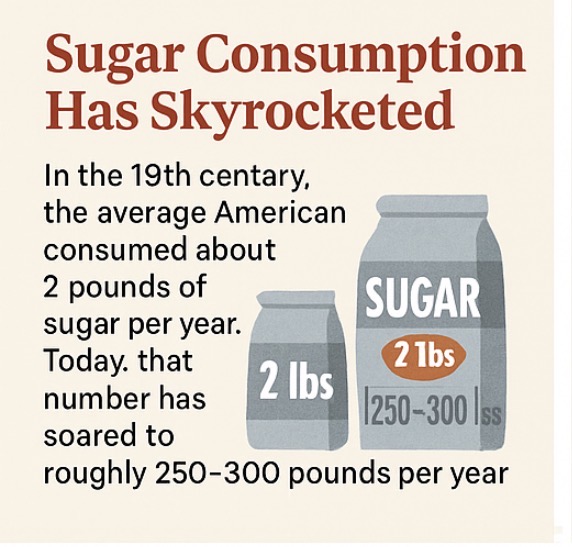
📊 Sugar- Then and Now:
You may have heard that “in Abraham Lincoln’s time, people ate just 2 pounds of sugar a year — now we eat 300.”
That comparison captures the magnitude of change, but the best evidence paints a slightly different picture.
Historical estimates suggest that in the 18th century, sugar consumption averaged 4–8 pounds per person per year — still minimal.
By the early 1900s, industrialization and global trade had made sugar cheap and abundant, driving intake up more than tenfold.
Today, despite countless “low-fat,” “organic,” and “whole-grain” labels, Americans are still averaging 60–80 pounds of added sugar each year, hidden in processed foods, beverages, sauces, condiments, and snacks.
That’s the equivalent of roughly 20 teaspoons of added sugar every single day — often consumed before lunch.
The takeaway isn’t to fixate on exact numbers, but to see the shift in culture: sugar moved from rare to routine, and disease followed right behind.
🍎 Teaching Kids the Truth About Sugar — and the Taste of Real Food:
We’re raising children in an era of convenience — where bright packages and cartoon mascots have replaced farm stands and family kitchens. Sugar isn’t just in desserts anymore; it’s in yogurts, cereals, sauces, and “healthy” snacks.
As a culture, we’ve normalized not only sugar consumption but also the diseases it fuels — obesity, insulin resistance, chronic inflammation, mood swings, and early-onset metabolic syndrome.
But here’s the truth: it’s never too late to change that.
Even small shifts at home can reprogram a child’s palate and metabolism for life. Instead of teaching kids that “treats” must be processed, we can re-introduce them to the sweetness of real food — the kind our Creator designed us for.
Better Sweet Choices for Children:
🍓Whole fresh fruits — especially lower-glycemic options like berries, apples, pears, and citrus, which deliver fiber and antioxidants that blunt sugar spikes.
🍠Naturally sweet vegetables like roasted carrots, beets, and sweet potatoes — beautiful, colorful, and nourishing.
🥥Healthy fats — avocado, nut butters, coconut — to pair with fruit for lasting energy.
🍯Natural flavor enhancers like cinnamon, vanilla, or raw cacao to satisfy cravings without triggering insulin surges.
💧Hydration first — thirst often masquerades as hunger; try infused water with mint, cucumber, or lemon.
Our goal isn’t to forbid sweetness — it’s to help children rediscover what “sweet” was meant to be.
When sweetness returns to its natural source, the body recalibrates: blood sugar stabilizes, moods even out, and the immune system strengthens.
🙏 Grounded in Faith, Guided by Stewardship:
As parents, we are stewards — not only of our children’s hearts but also of their health.
Scripture reminds us, “Train up a child in the way he should go; even when he is old he will not depart from it.” (Proverbs 22:6)
That training includes the way they view food, gratitude, and nourishment.
We have the power to teach them that real food is a gift — not a punishment — and that the sweetest life is one lived in balance, gratitude, and vitality.
🍃 Final Word:
The Nature Medicine findings confirm what many parents already sense: sugar isn’t harmless. It can set the stage for lifelong inflammation and disease — but awareness, education, and small daily choices can rewrite that story.
Every meal is a message to the body.
Let’s make it one that says:
You were designed for nourishment, not numbers on a label.